
Two plants in the same sector decide to convey the same ingredient. Both compare suppliers, both ask for advice and both end up choosing the same pneumatic conveying technology. On paper, they bought the same thing.
A year later, one of them has a line that runs without anyone giving it a thought. The other lives with recurring blockages, higher energy use than expected and a section of pipe that needs checking every few months.
The paradox is that nobody chose the wrong technology.
What changed was the route the ingredient has to travel inside each plant. How many times it turns, how far it goes, how many destinations share the same line and how the points where the product enters and leaves the system are handled.
That part isn’t in any catalogue. The route is designed on top of the plant that already exists, with its columns in the way and its limited headroom, and in pneumatic conveying system design it often carries as much weight as the technology connected at either end.
This article is about that conversation: what the route really decides, how to tell whether your installation’s problem lies there and what information to put on the table before asking for a quote so that two offers can genuinely be compared.
Índice
- 1. What the routing is and how much of the result it decides
- 2. Changes of direction: what a bend really costs
- 3. Distance and elevation: the drawing tells a small lie
- 4. When several destinations share the same line
- 5. Transitions: where the system stops behaving like a system
- 6. How to tell whether the problem is in the equipment or in the route
- 7. Correcting a route without rebuilding half the plant
- 8. What to bring to the table before asking for a quote
- 9. Why two quotes with the same equipment are not comparable
- 10. Frequently asked questions
- 11. How we approach this at Gashor
1. What the routing is and how much of the result it decides
The routing is the physical path the ingredient follows from where it is loaded to where it is discharged, with all its bends, its vertical sections, its branches and its transition points.
It is the part of the project you don’t buy: it is drawn on the real plant that already exists.
And it has far more influence than people tend to assume. The same blower, the same pipe and the same product can perform differently depending on how the route is resolved between the two ends.
The reason is simple to understand, even if it is laborious to calculate. The air has to overcome the resistance of the whole path, and that resistance is called pressure drop: every metre, every bend and every rise adds a little to it.
When the routing adds more resistance than expected, the system responds in one of these four ways, and none of them comes free:
- Conveying velocity goes up to maintain throughput, with more pipe wear and harsher treatment of the product.
- Air consumption goes up, and with it the energy bill of a line that runs every shift.
- Actual throughput drops below what production needs.
- Product starts to settle, when it loses velocity at some point and begins to drop out.
That last point is the most expensive one, because it almost never shows up on day one. It appears weeks later, in the form of blockages that the plant ends up treating as just part of the job…
… and by then nobody links them to a design decision.
Four route variables explain a good part of those differences: changes of direction, distance and elevation, destinations sharing a line, and transitions.
Let’s take them one by one.
2. Changes of direction: what a bend really costs
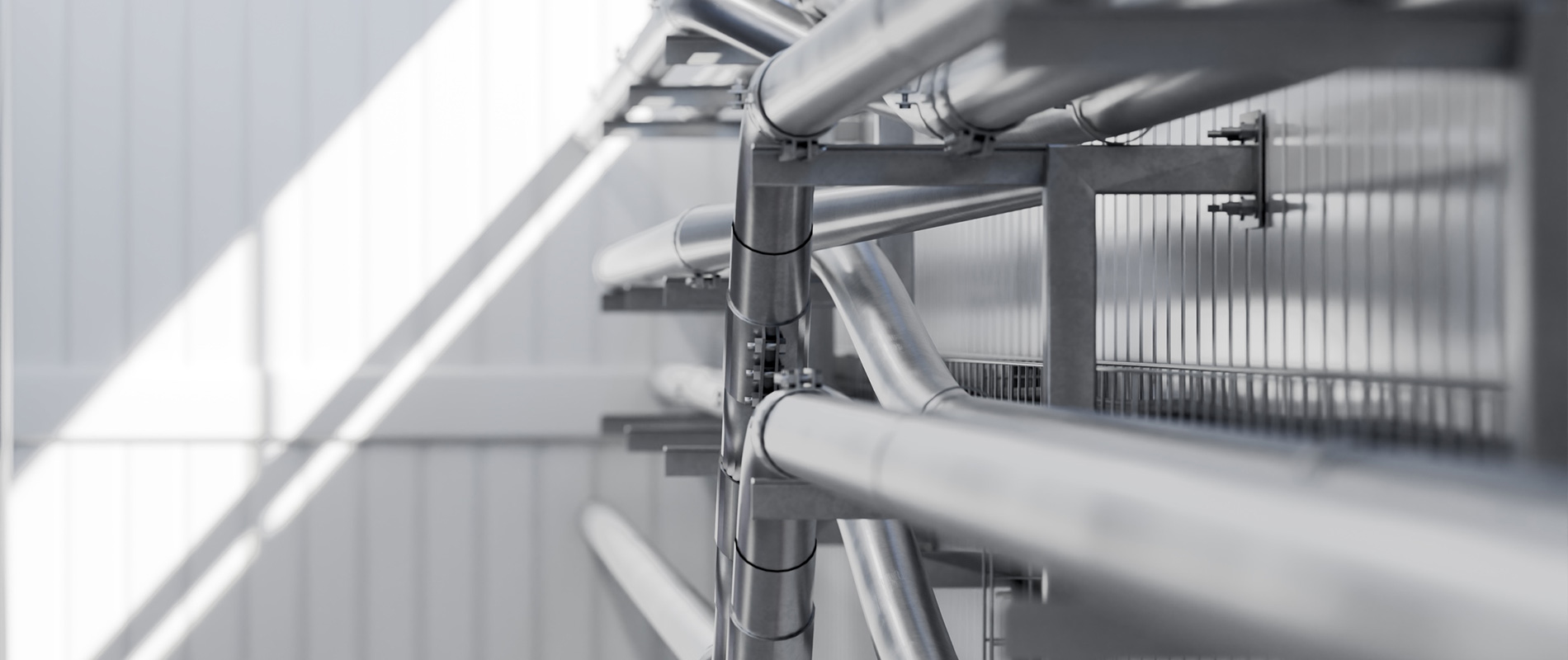
commonly used in the industry, it is assigned the equivalent of a straight run of between 5 and 12 metres of pipe.
A turn that takes up half a metre on the drawing can weigh in the calculation like an entire corridor.
And here comes the fact that says most about this trade: that equivalent is not the same in every calculation criterion. The simplified method usually assigns around 5 metres per bend, the Rhodes reference raises it to 7.5, and the Agarwal method distinguishes between short-radius bends, at around 12 metres, and long-radius bends, at around 6.
The fact that there are several different criteria for the same component is precisely the sign that there is no off-the-shelf answer here. There is an engineer deciding what margin to work with, depending on the product, the installation and what is at stake on that line.
Besides adding resistance, every change of direction concentrates other effects that tend to appear together:
- Wear at the point of impact. The product always strikes the same spot on the bend, and with abrasive materials that spot sets the maintenance schedule for the whole line.
- Risk of settling. If the product loses too much velocity in the turn, it can stay behind, and that is the origin of many recurring blockages.
- Stress on the product. After every impact the material slows down and has to be accelerated again, and some ingredients suffer from that treatment more than others.
That is why the bend radius is a design decision, not an assembly detail.
As a reference, a bend radius to pipe diameter ratio of roughly 8 to 14 is usually considered a good compromise between pressure drop, wear and space taken up.
A tighter radius saves space and is usually cheaper to install. What it saves at installation can end up being paid for in energy and maintenance, shift after shift, over the next fifteen years. That sum is rarely done.
3. Distance and elevation: the drawing tells a small lie
The distance that counts adds up the horizontal, the vertical and every singularity along the way. A ruler on the drawing always gives a more optimistic number than the one the air will have to overcome.
Process engineers work with equivalent length, which translates the whole route into metres of straight pipe.
In that translation there is a rule that surprises many people the first time they hear it: a vertical section usually counts for roughly twice the same section run horizontally. (Going up costs more, here too.)
This has a very concrete practical consequence for anyone sizing a project. Two plants where the route spans the same thirty metres on the layout can have very different equivalent lengths if one runs it in a straight line and the other has to clear a structure, go around a walkway and climb to a mezzanine.
That is the source of one of the most frequently asked questions, and the honest answer is a little uncomfortable: there is no universal maximum distance in pneumatic conveying. There is a combination of product, throughput, available pressure and route that either holds up or doesn’t.
So when someone asks how many metres can be covered, the useful counter-question is usually how many equivalent metres, and that figure only appears once someone has looked at the real plant.
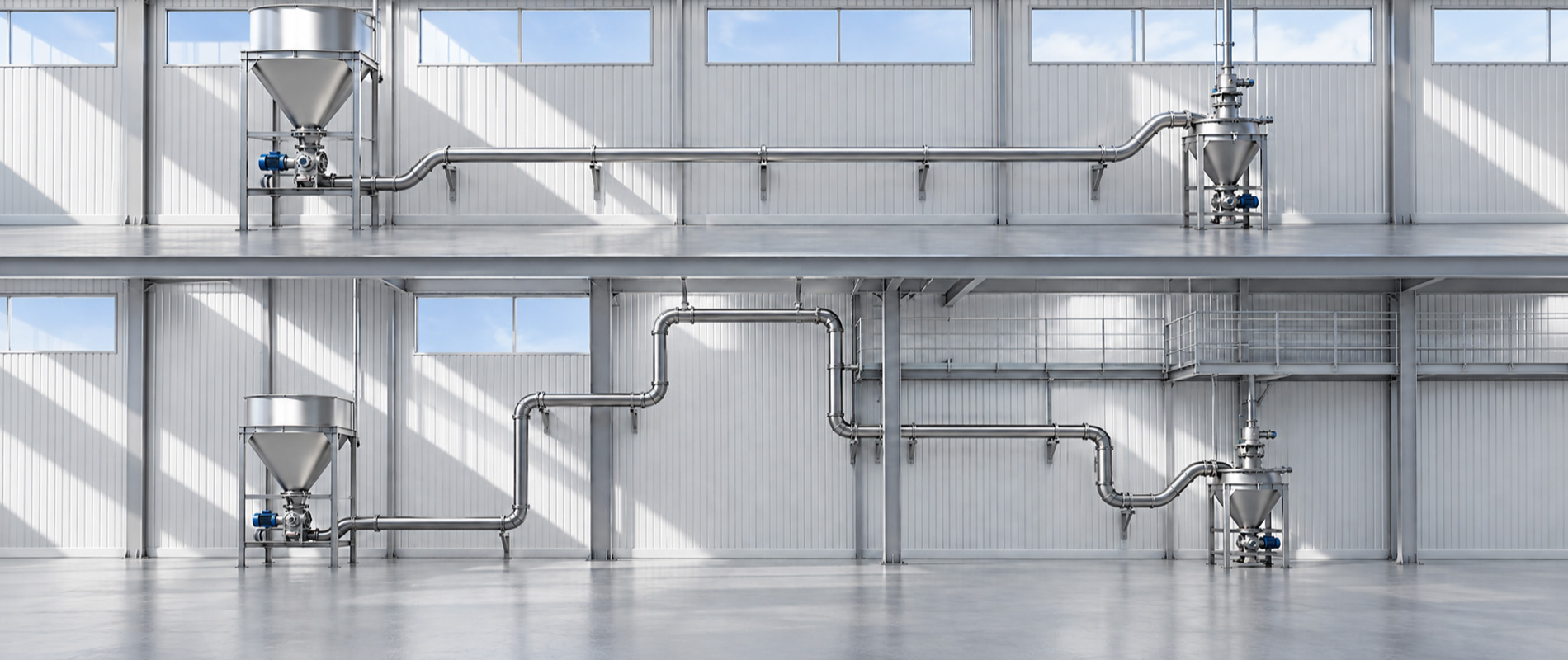
Sharing one line between several destinations is almost always a sound economic decision, and it is always a process decision.
A single line feeding three silos saves pipework, saves equipment and saves space.
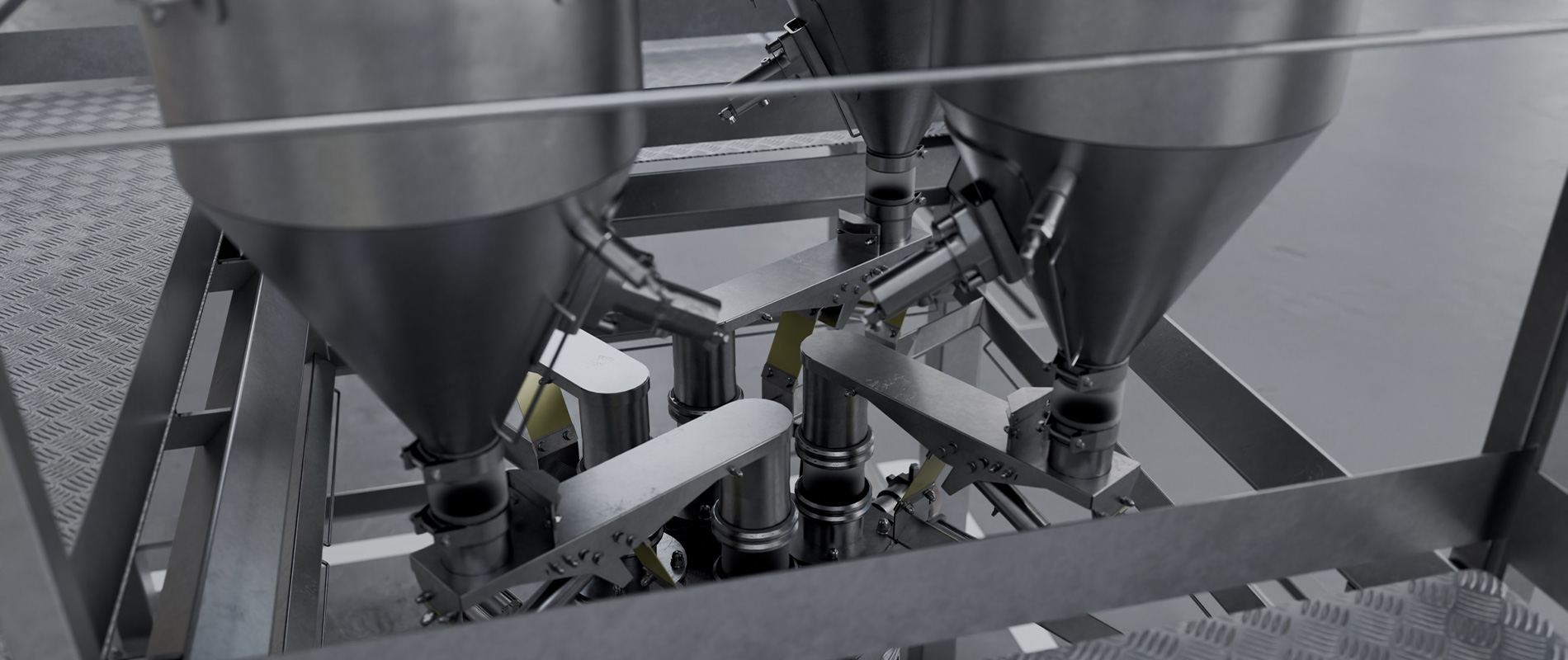
Distribution is handled with diverter valves, which direct the product to one destination or another. It is a standard, well-proven solution in the industry, with one nuance worth keeping on the radar from the start.
Some valve designs can retain a small amount of product, and in an installation that alternates recipes or handles allergens, that residue is exactly the kind of detail that is hard to explain later in an audit.
There are configurations designed specifically to minimise that risk, and choosing one or another depends on what is being conveyed.
The underlying question, then, comes up long before the valve is bought. Which products will share that section, and what happens if one leaves a trace of the previous one?
When the answer is “nothing significant”, sharing a line is an excellent idea. When the answer involves an allergen, an active ingredient or two recipes that must not mix, the conversation moves from budget to risk. We covered this in depth when we wrote about cross-contamination and audits.
5. Transitions: where the system stops behaving like a system
The points where the product enters and leaves the conveying system tend to cause the most problems, and receive the least attention at quotation stage. Big bag discharge, a silo outlet, the inlet to a weigh hopper, the connection to the batching station…
At those points velocity, cross-section and sometimes technology all change. A product that travels perfectly through the pipe can behave differently as it enters or leaves it, and that is where hold-ups, dust leaks and differences between what is sent and what arrives appear.
It is also where the difference between an integrated installation and a collection of sound equipment shows most clearly. Each piece of equipment can meet its specification and the whole can still fail to work, because nobody took care of what happens at the seams.
When conveying is designed together with the storage it starts from and the batching system it feeds, those transitions stop being no man’s land. That is the logic we apply to pneumatic conveying at Gashor.
6. How to tell whether the problem is in the equipment or in the route
There is a fairly reliable sign: if the problem always appears at the same point on the line, the route probably has something to do with it. Equipment that fails tends to fail in scattered ways. A poorly resolved route tends to fail with almost irritating punctuality.
These are the signs that, in our experience, point more to the path than to the machine:
| What you see on the plant floor | What usually lies behind it |
| Blockages that always recur in the same section | Loss of velocity at that point on the route, often after a bend or a rise |
| One particular bend that has to be replaced long before the rest | Radius too tight or excessive velocity in that section |
| Actual throughput falls short of the project design | Equivalent length greater than calculated |
| Energy consumption above estimates from day one | Route resistance higher than allowed for at sizing stage |
| Differences between what is sent and what reaches the destination | Hold-ups at transitions, in diverters or at accumulation points |
| The system works with one product and struggles with another | Route sized for a different behaviour from that of the current ingredient |
The last row deserves a closer look, because it is increasingly common. Many installations that cause problems today were correct the day they were designed. What changed afterwards was the recipe, the ingredient supplier, the production volume or the number of products running through the same line.
7. Correcting a route without rebuilding half the plant
A route that could be improved almost never means scrapping the installation. It is one of the ideas we most often have to dismantle in first meetings, because the suspicion that the solution means starting from scratch tends to block the project before anyone has measured anything.
In practice, many interventions on the route are limited in scope and phased: changing the radius of a critical bend, removing an unnecessary turn by redistributing the pipe supports, reviewing the diameter of a specific section, re-engineering a problematic discharge point.
This work also has a natural window. Defects are detected during production, because that is when blockages, noises and throughput differences appear. The intervention is planned afterwards, with the line down, during whatever shutdown each plant has scheduled.
It is the same logic of intervening only where it hurts that we apply to plant refurbishment, and in pneumatic conveying it tends to pay back quickly because it acts on energy and maintenance costs that are paid every single day.
8. What to bring to the table before asking for a quote
If you want comparable offers, the information about the route has to be in the request, not surface during installation. Here is the short list of what any engineering team needs to size a project properly:
| Data | Why it shapes the route |
| What the product is and how it behaves | Density, particle size, fragility, abrasiveness and tendency to compact set velocities and radii |
| What throughput production requires | It defines diameter and pressure, and with them how well the system tolerates a long route |
| Horizontal distance and height to be overcome | It is the basis of equivalent length, with vertical runs weighing more |
| How many turns the plant layout forces | Every change of direction adds resistance, wear and a risk point |
| How many sources and how many destinations | It determines whether a line has to be shared, and the implications for carry-over between products |
| What hygiene requirements apply | Allergens, recipe changes and the sector shape diverters, joints and access points |
| What space constraints there are | Structures, walkways and clear heights are what end up drawing the route |
| What growth is expected | A route tuned to the millimetre for today may fall short with next year’s product |
That last question is the one asked least and missed most. An installation is also sized for the plant you will be three years from now.
9. Why two quotes with the same equipment are not comparable
Because the equipment is the visible part of the project and the route is what decides how it behaves. Two offers can list the same blower, the same pipe diameter and the same technology, and describe installations that will perform very differently.
The difference usually lies in what doesn’t appear in the comparison table: how many bends each proposal allows for and with what radii, what calculation margin each engineering team has applied, how each one handles the transitions and what happens when a new product comes in.
When two prices are far apart for the same equipment, there is almost always a technical explanation behind it. It is worth asking them to explain it, because that conversation says more about the supplier than the offer itself.
10. Frequently asked questions
How much does a 90-degree bend penalise a pneumatic conveying line?
Common calculation methods assign a 90-degree bend the equivalent of between 5 and 12 metres of straight pipe.
The range depends on the criterion used and the bend radius, with short-radius bends at the top and long-radius bends at the bottom. The practical conclusion is that a turn weighs far more than the space it takes up.
How many changes of direction can a line have?
There is no maximum number. There is a pressure drop budget shared out between distance, height and turns.
A short line can take more bends than a long line with the same equipment. The sensible approach is to design the route looking for the path with the fewest turns the plant allows, and to resolve the unavoidable ones well.
What radius should the bends have?
As a general reference, a bend radius to pipe diameter ratio of around 8 to 14 usually offers the best balance between pressure drop, wear and space taken up.
With fragile or abrasive products it usually pays to go for more generous radii, and there are specially designed bends for demanding cases.
How far can an ingredient be conveyed?
It depends on the combination of product, throughput, available pressure and route, not on a fixed number.
The relevant figure is equivalent length, which adds up the horizontal, the vertical (weighted more heavily) and the singularities along the way. Two installations separated by the same distance on the drawing can be very different equivalent distances apart.
Can a single line feed several destinations?
Yes, and it is a common, efficient configuration, handled with diverter valves.
The point to assess before deciding is which products share that section, because some valve designs can retain a small amount of material. In installations with allergens or frequent recipe changes, that choice is best made at the start of the project.
How do I know whether my problem lies with the equipment or the routing?
If the fault always appears at the same point on the line, the route usually bears part of the responsibility.
Repeated blockages in the same section, a bend that wears out before the rest or throughput below design from day one point to the design of the path more than to the machine.
Can the routing of an existing installation be improved?
In most cases, yes, and without rebuilding the entire installation.
The most common interventions are limited in scope: modifying the radius of a critical bend, removing a turn, adjusting the diameter of a section or re-engineering a discharge point. The problem is detected during production and addressed in the next shutdown window.
What information does the engineer need to give me a serious quote?
How the product behaves, the throughput, the distance and height, the number of turns the plant imposes, how many sources and destinations there are, the hygiene requirements of the sector and the space constraints.
With that data, two offers can be compared. Without it, you are comparing equipment lists.
11. How we approach this at Gashor
Since 1959 we have been designing installations on real plants, with columns in the way, limited headroom and walkways that cannot be blocked. That is the part of the trade that doesn’t fit in a catalogue, and that we now apply in more than fifteen countries.
Our approach to a pneumatic conveying project rests on four areas that work together:
- Gashor Consulting: prior diagnosis of the process and the installation, before proposing anything. This is where the real route is measured.
- Gashor Industry: custom design and manufacturing in Zizurkil, tailored to the plant you have.
- Gashor Innovation: automation and industrial artificial intelligence that analyses more than 130 variables in the process, always on your own servers.
- Gashor Services: commissioning, maintenance and spare parts throughout the entire service life, with local teams in Spain, Mexico and South Africa.
Choosing the technology is usually the quick part of a project. The route is drawn on top of your plant, and it is what will stay with you for the next fifteen years.
That is why our conversations start by looking at the path your ingredient has to travel, before the equipment that will move it.
If you have a project on the table or a line that has been causing problems at the same point for a while, tell us where your ingredient goes. That is usually the best place to start.

